|
|
Lee Gettess brings us both an article and a video this week. First, Gettess discusses using the
oscillators. Lee also gives us his
up-coming market predictions in Lee
Gettess' Market Sense.
The next article for Adam Oliensis explains the RSI.
Last, Norman Hallett presents a video on the importance of taking time off.
Enjoy!
Adrienne LaVigne
TradeWins Publishing
Sometime
in the mid to late 1980's, I was first introduced to the concept of using a
price oscillator to measure the underlying momentum of the market. A trader named Tom Joseph utilized a 5/35
oscillator to help him identify the correct Elliott Wave sequence on the chart
he was working with. Well, Elliott has
so many alternate counts that I never had a clue what the wave structure really
was, but I did like the way Tom used the 5/35 oscillator. 5/35 means that you take a five period moving
average and subtract it from a 35 period moving average. Whether you use closing prices, average
prices, or midpoints doesn't change things much, so I tend to use the
closes. The difference between these two
moving averages is then plotted below your price chart. As with all of the indicators we will be
using, most commercially available software packages have the ability to do
this as part of their standard equipment.
The oscillator
Lee Gettess' Market Sense
Lee Gettess is a top trader who is excited to bring you his video newsletter.
Each week, Lee will share his predictions on what he anticipates from the bond
and S&P markets.
Click the above image to view the video
Relative Strength Index-RSI(P)
The
following is an excerpt from Adam Oliensis's Stock Chart
Analysis and the Dynamic Trading System
Despite
the name, the RSI does not measure a stock's strength relative to the market or
to another security. It measures the
strength of a stock's upward moves relative to the strength of its downward
moves over a given period. RSI is an
extremely popular price momentum indicator.
It was derived by J. Welles Wilder and is described in detail in his book,
"New Concepts in Technical Trading Systems."
The
formula for RSI is:
RSI =
100 - 100/(1 + RS(P))
The RSI
Norman
suggests something that you may not have had somebody suggest to you before...
and that is "take some time off." He explains exactly what he means
in this week's 4-Minute Drill for Traders.
Watch video
|

Lee Gettess
Growing
up in inner-city Detroit,
Lee started his career at the very bottom-mopping floors at General
Motors. Although being a janitor is honest work, and certainly no
disgrace, Lee had a much grander lifestyle in mind.
Believing
that more people achieve greater riches in a shorter period of time trading
than in any other business in the entire world, he spent every spare minute he
had studying the markets. By 1987 his profits provided a sufficient stake
for him to quit his job and trade for a living...The rest is history.
20-Year Veteran Trader Reveals Secrets Of How To Aim For Over
$1,500 A Week When You First Start Trading...Over $6,000 A Week After 1 Year!!
HOW TO
STRIVE FOR PROFITS BEYOND YOUR WILDEST DREAMS
Lee Gettess, a veteran of more 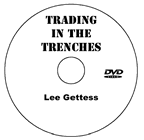 than
10 years of trading "in the trenches," has written an amazing book
that shows how you - or anyone - can aim to make a ton of money trading from
home. than
10 years of trading "in the trenches," has written an amazing book
that shows how you - or anyone - can aim to make a ton of money trading from
home.
I'm not
talking about $20,000 or $30,000 a year. I'm talking about $1,500 a week
($75,000 a year) to start...and more than $6,000 a week ($300,000 a year!)
within 6-12 months.
Lee knows what he's talking about.
About 10 years ago, Lee quit the
"rat race" to trade futures for a living. (He hesitates to call it a
"full-time" job, because he only spends a half-hour or so a day at
it!) Today, futures trading is Lee's
only means of income - and he's making more money than ever before!
Learn
more about Trading in the Trenches
Andy Chambers
Chuck
Hughes
Chris Verhaegh
Connors & Hayward
Dale Brethauer
Darrell
Jobman
Dave
Caplan
Ken
W. Chow
Peter
McKenna
Ray
Frazier
Tom
DeMark
Tony
Catalfamo
|
PLEASE READ.
Past results are not necessarily indicative of future results. There is a substantial risk of loss trading
commodities, stocks, bonds and options with or without this or any other advertised product, service or
system. Also hypothetical or simulated
performance results have certain inherent limitations. Unlike an actual performance record,
simulated results do not represent actual trading. Since the trades have not actually been
executed, the results may have under-or-over compensated for the impact, if any,
of certain market factors, such as lack of liquidity. Simulated trading programs in general are
also subject to the fact that they are designed with the benefit of
hindsight. No representation is being
made that any account will or is likely to achieve profits or losses similar to
those shown.
|
|
|


