|
|
Dave Caplan is our featured author this week. In his article, Dave discusses how volatility
affects strategy decisions.
Lee Gettess provides the next segment with his regular video newsletter
explaining his market expectations for the coming week.
Then, Chris Verhaegh discusses straddles and strangles.
Last, Norman Hallett presents a video on timing in your trading.
Enjoy!
Adrienne LaVigne
TradeWins Publishing
Strategy Decisions Based on Market Volatility
The
following is an excerpt from Dave Caplan's The
Option Secret
Most
stock and futures traders are familiar with approaches to option strategies
that rely upon overbought or oversold levels of the underlying instrument. While it is not always easy to measure what
is overbought or oversold, approaches generally use trading volume, rate of
ascent (or descent) of the price of the instrument, or more exotic things such
as oscillators. Option strategies can
then be constructed about one's outlook for the underlying. For example, if a stock is determined to be
oversold, then one would want to employ bullish strategies. These might vary from the aggressive
(outright call purchases) to the moderate (bull spreads), to the basically
conservative (naked put sales - the equivalent of covered call writing). Of course, the option trader should not
entirely ignore the pricing structure of the options. If the options are priced unfavorably, he may
want to switch strategies or he may just buy the underlying common stock and
not use options at all. A futures trader
would make analogous decisions.
Conversely if a stock or futures contract were determined to be
overbought then strategies such as put purchases (aggressive) or bear spreads
(moderate) would be in order.
Trading based on volatility
Lee Gettess' Market Sense
Lee Gettess is a top trader who is excited to bring you his video newsletter.
Each week, Lee will share his predictions on what he anticipates from the bond
and S&P markets.
Click the above image to view the video
Heads You Win, Tales You Also Win
The following is a
clip from Chris Verhaegh's Money from
Nothing
In this clip from Chris Verhaegh's "Money from
Nothing DVD," Chris looks at
straddles and strangles. Verhaegh explains the benefits of this type of trading.
What can the trader expect? Last, he details several aspects of directionless
trading
Watch
video
Click the above image to view the video
This
week Norman talks about TIME in relation to trades and taking trades. In
trading, time can be your best friend or your worst enemy... it really depends
how you handle time... whether you're in control of time... or time is in
control of YOU.
Norman talks about how we can manage and control
time in our trading. He gives tips on how to make time follow YOUR rules.
Watch video
|
Dave Caplan founded
and is former President of Opportunities in Options in Malibu, Calif.,
a firm that specializes in analyzing and identifying potential option trades
with the best returns and the lowest risks. A pioneer in innovative option
trading strategies, he is the author of several best-selling books including The Options Advantage, The Options Secret and Trade Options Like a Bookie.
David
L. Caplan's
The Option Secret
This
book is an indispensable 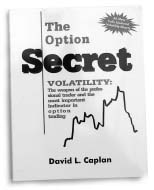 tool for all option traders. Inside, renowned
publisher, speaker and author Dave Caplan explains how to use volatility as a
measure of under- and over-valuation on any option. This, according to Caplan,
can put the odds of success
(profitability) in your favor up to 90% of the time. Coupled with the limited
risk inherent in options, that measurement of volatility is the true key to
realizing consistent profits in options. Caplan explains it all, in clear and
concise language, in the pages of this breakthrough book. And you can get a
copy now at half the regular price. Supplies are limited, so order soon! tool for all option traders. Inside, renowned
publisher, speaker and author Dave Caplan explains how to use volatility as a
measure of under- and over-valuation on any option. This, according to Caplan,
can put the odds of success
(profitability) in your favor up to 90% of the time. Coupled with the limited
risk inherent in options, that measurement of volatility is the true key to
realizing consistent profits in options. Caplan explains it all, in clear and
concise language, in the pages of this breakthrough book. And you can get a
copy now at half the regular price. Supplies are limited, so order soon!
Learn more about the #1 option trading weapon
Andy Chambers
Chuck
Hughes
Chris Verhaegh
Connors & Hayward
Dale Brethauer
Darrell
Jobman
Dave
Caplan
Ken
W. Chow
Peter
McKenna
Ray
Frazier
Tom
DeMark
Tony
Catalfamo
|
PLEASE READ.
Past results are not necessarily indicative of future results. There is a substantial risk of loss trading
commodities with or without this or any other advertised product, service or
system. Also hypothetical or simulated
performance results have certain inherent limitations. Unlike an actual performance record,
simulated results do not represent actual trading. Since the trades have not actually been
executed, the results may have under-or-over compensated for the impact, if any,
of certain market factors, such as lack of liquidity. Simulated trading programs in general are
also subject to the fact that they are designed with the benefit of
hindsight. No representation is being
made that any account will or is likely to achieve profits or losses similar to
those shown.
|
|
|